小學時,老師成日要我哋寫我的志願,志願來來去去都喺果幾樣:男仔做消防員、警察;女仔做護士、老師...
人生既過程,喺不停噉了解自己,尋找真我.... 過程中會有迷失,例如,會跟隨大部份人認為啱既方向行,而忽略自己的想法同感受;或因為在意別人對你的評價而改變自己。
活咗幾十年既我,亦繼續不停了解自己...
成日以為自己既人生目標喺要搵多啲錢住大屋,但有啲物質既嘢到手之後,個人就會好空虛...
到近日發現,自己最想既,原來喺同自己最愛既人,去世界唔同既角落,開闊眼界。
完全唔洗豪嘆世界,住五星級酒店;我哋反而喜歡住旅舍(hostel),因為住旅舍要同人共用厠所廚房,响果道,你就有機會接觸唔同國籍既人,了解佢哋既文化。
其實响2011年既芬蘭之旅,我就開始了解自己呢個想法... 果次我哋大部份時間住旅舍,碰到俄羅斯人、澳洲人、瑞典人.... 同佢哋傾談吓,真喺幾得意!
『讀萬卷書不如行萬里路』
身為地球人,真喺應該了解多啲呢個世界!
雖然行咗萬里路之後不會為我帶來百萬既金錢,但對我來說,會令我人生無憾!
2012年7月29日 星期日


2012年7月28日 星期六


2012年7月25日 星期三
【6 of 10 注】增持建設銀行(939)
日期 買入價 PE 年息 恒指收市
(4) 30/09/2011 $4.80 7.3 5.2% 17,592
(5) 09/05/2012 $5.70 6.8 5.1% 20,330
(6) 25/07/2012 $4.84 5.6 6.0% 18,877
(1) 12/08/2011 $5.43 8.2 4.6% 19,620
(2) 18/08/2011 $5.28 8.0 4.7% 20,016
(3) 22/09/2011 $5.12 7.8 4.9% 17,911(4) 30/09/2011 $4.80 7.3 5.2% 17,592
(5) 09/05/2012 $5.70 6.8 5.1% 20,330
(6) 25/07/2012 $4.84 5.6 6.0% 18,877
2012年7月22日 星期日
How To Read a Wine Label
New World:
New World wine labels are pretty user friendly, offering consumers a few key pieces of wine buying information. The varietal is listed on the label, making for less guesswork than many Old World labels. The producer, varietal, vintage year, region where grapes are grown, and alcohol content typically appear on the front label. The back label sports the government warning, "According to the Surgeon General..." and the sulfite statement along with some witty wine wisdom and pairing preferences for the particular wine.

Alsace(FR):
Alsatian wine labels tend to be easier on the New World consumer, as they are the one French wine region that habitually states the wine’s grape varietal directly on the front label. These labels are a good place to start easing into Old World label decoding, because they provide a "hybrid" of Old World and New World labeling strategies. The detective work is significantly reduced as consumers conquer the label offerings in record time, but easy label deciphering aside, the majority of Alsatian Rieslings need little help in convincing consumers to give them a go. Alsace has an international reputation for producing tip top Rieslings at consumer-friendly price points - this particular Lucien Albrecht Riesling is no exception.
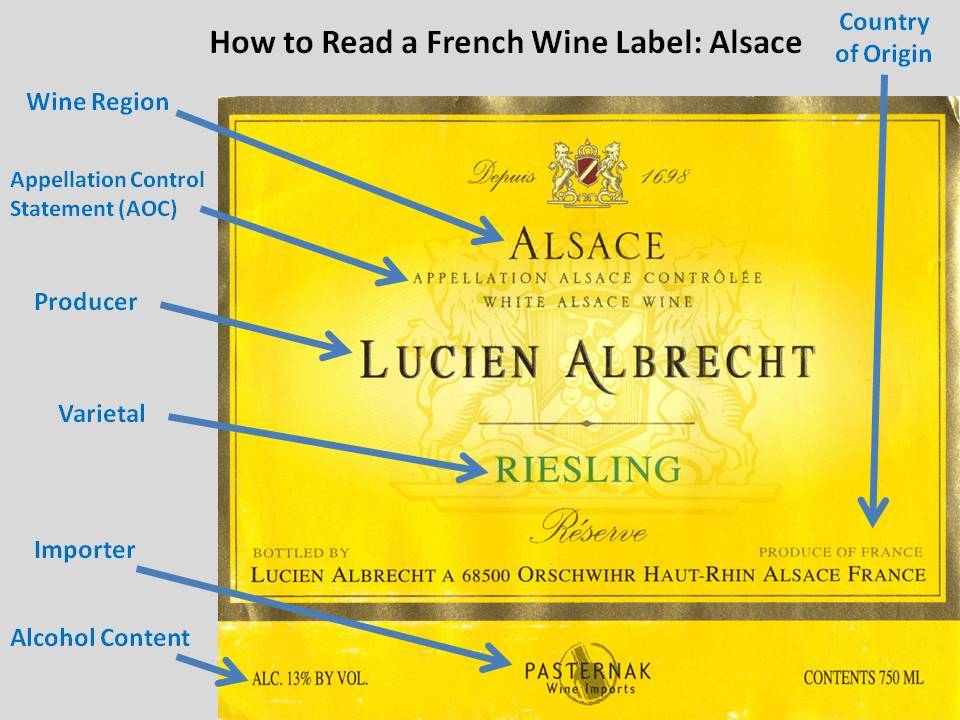
France:
It is from Burgundy (decoded by the phrase in the top right corner “Vin de Bourgogne,” meaning “Wine of Burgundy” in French). In Burgundy there are two main wines to know: Red Burgundy (Pinot Noir) and White Burgundy (Chardonnay). These two wines comprise the majority of the region’s wine, with Chablis, Gamay and some sparkling wines rounding out the rest of Burgundy’s wine offerings. This label represents a white wine from Burgundy, which we figure out from bottle and label clues. First, the bottle will have the sloped shoulder style that is typically found in white wines (and Pinot Noir) where there is no need for a sediment lip. You'll also be able to see that it is a white wine through the green glass, instead of red wine. Next, it's critical to take some time to get to know key appellations in the dominate wine regions of France. These appellations will tip you off on which grapes are likely in the bottle of wine. So for this particular label, we know that the region where the wine’s grapes were grown is Burgundy (via the top left corner of the label, designated "Vin de Bourgogne"). Next, the specific appellation in Burgundy is Macon-Villages (known for stellar white Burgundy wines, aka Chardonnay). The precise estate where the grapes are from is listed as "Domaine Champ de Brulee" (literally translated to “Burnt Field” – referring to the specific vineyard’s optimal sun exposure). The wine's producer is Vincent (an extension of the Chateau Fuisse Estate) and the bottling information is found at the bottom of the label. All in all, we know that this is a Chardonnay from Burgundy produced by JJ Vincent in 2003 with an alcohol content of 12.5%. Other terms that you may encounter on French wine labels include: "Blanc" - meaning "white"; "Cru" - typically meaning "vineyard"; "Grand Cru" - meaning "Great growth" designating a vineyard of exceptional reputation and quality; "Cuvee" - meaning "blend" of grapes or wines; "Domaine" - meaning "estate"; "Rouge" - meaning "red"

German:
The vast majority of German wines are Rieslings, and for good reason. Germany has been setting the traditional standard for the Riesling grape for centuries. The German wine label includes the basic information found on most other labels: producer, region, vintage, vineyard, varietal, and the like, but they throw a curve when the ripeness levels, sugar levels and quality classifications also grace the label. The quality classification starts off with the basic table wine, "Tafelwein" and proceeds to a level 5 designation of "Qualitätsweine mit Prädikat" (QmP) - translated to "Quality wine with attributes." This is the quality classification of the featured wine label above. At this level 5 quality classification, the ripeness classification system kicks in to further designate who's who in the world of German Riesling. The ripeness classification system communicates when the grape was picked, so it's an indicator of initial grape sugar levels not final bottled residual sugar levels. The wines in ascending ripeness level order are as follows: Kabinett (least ripe, lightest style), Spätlese, Auslese, Beerenauslese (BA), and Trockenbeerenauslese (TBA - a late harvest, Botrytis picking - most ripe, fullest body). There are also label residual sugar indicators to keep in mind: if the wine is dry, it is labeled as "Trocken"; "Halbtrocken" is off-dry and sweeter Rieslings are designated as "Beernauslese" (BA)and "Trockenbeerenauslese" (TBA).

Italy:
The primary pieces of information that Italian wines want to communicate to you, their celebrated consumer, are the wine's: Name, Growing Region (There are 37 designated wine growing regions in Italy), Grape Type (Italy has over 2,000!), Estate and Producer Names, Alcohol Content, Vintage Year and Classification (Vdt, IGT, DOC, DOCG - government appellation designations related to volume, location and quality). If you can grab these key pieces of information off of an Italian wine label then you are good to go.

訂閱:
文章 (Atom)