New World:
New World wine labels are pretty user friendly, offering consumers a few key pieces of wine buying information. The varietal is listed on the label, making for less guesswork than many Old World labels. The producer, varietal, vintage year, region where grapes are grown, and alcohol content typically appear on the front label. The back label sports the government warning, "According to the Surgeon General..." and the sulfite statement along with some witty wine wisdom and pairing preferences for the particular wine.
Alsace(FR):
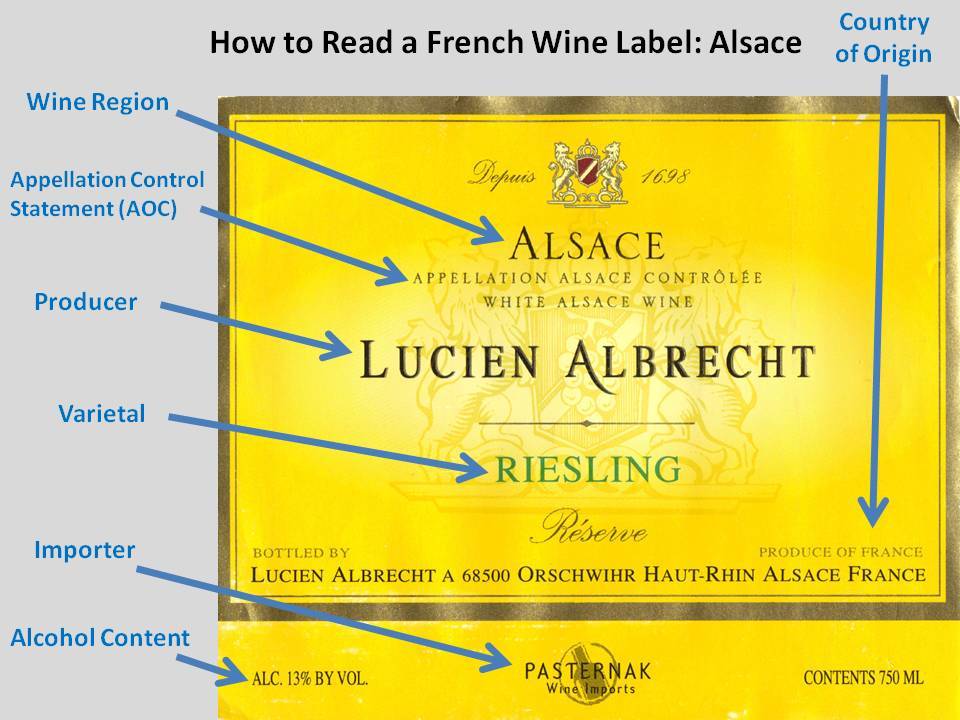
Alsatian wine labels tend to be easier on the New World consumer, as they are the one French wine region that habitually states the wine’s grape varietal directly on the front label. These labels are a good place to start easing into Old World label decoding, because they provide a "hybrid" of Old World and New World labeling strategies. The detective work is significantly reduced as consumers conquer the label offerings in record time, but easy label deciphering aside, the majority of Alsatian Rieslings need little help in convincing consumers to give them a go. Alsace has an international reputation for producing tip top Rieslings at consumer-friendly price points - this particular Lucien Albrecht Riesling is no exception.
France:
It is from Burgundy (decoded by the phrase in the top right corner “Vin de Bourgogne,” meaning “Wine of Burgundy” in French). In Burgundy there are two main wines to know: Red Burgundy (Pinot Noir) and White Burgundy (Chardonnay). These two wines comprise the majority of the region’s wine, with Chablis, Gamay and some sparkling wines rounding out the rest of Burgundy’s wine offerings. This label represents a white wine from Burgundy, which we figure out from bottle and label clues. First, the bottle will have the sloped shoulder style that is typically found in white wines (and Pinot Noir) where there is no need for a sediment lip. You'll also be able to see that it is a white wine through the green glass, instead of red wine. Next, it's critical to take some time to get to know key appellations in the dominate wine regions of France. These appellations will tip you off on which grapes are likely in the bottle of wine. So for this particular label, we know that the region where the wine’s grapes were grown is Burgundy (via the top left corner of the label, designated "Vin de Bourgogne"). Next, the specific appellation in Burgundy is Macon-Villages (known for stellar white Burgundy wines, aka Chardonnay). The precise estate where the grapes are from is listed as "Domaine Champ de Brulee" (literally translated to “Burnt Field” – referring to the specific vineyard’s optimal sun exposure). The wine's producer is Vincent (an extension of the Chateau Fuisse Estate) and the bottling information is found at the bottom of the label. All in all, we know that this is a Chardonnay from Burgundy produced by JJ Vincent in 2003 with an alcohol content of 12.5%. Other terms that you may encounter on French wine labels include: "Blanc" - meaning "white"; "Cru" - typically meaning "vineyard"; "Grand Cru" - meaning "Great growth" designating a vineyard of exceptional reputation and quality; "Cuvee" - meaning "blend" of grapes or wines; "Domaine" - meaning "estate"; "Rouge" - meaning "red"

German:
The vast majority of German wines are Rieslings, and for good reason. Germany has been setting the traditional standard for the Riesling grape for centuries. The German wine label includes the basic information found on most other labels: producer, region, vintage, vineyard, varietal, and the like, but they throw a curve when the ripeness levels, sugar levels and quality classifications also grace the label. The quality classification starts off with the basic table wine, "Tafelwein" and proceeds to a level 5 designation of "Qualitätsweine mit Prädikat" (QmP) - translated to "Quality wine with attributes." This is the quality classification of the featured wine label above. At this level 5 quality classification, the ripeness classification system kicks in to further designate who's who in the world of German Riesling. The ripeness classification system communicates when the grape was picked, so it's an indicator of initial grape sugar levels not final bottled residual sugar levels. The wines in ascending ripeness level order are as follows: Kabinett (least ripe, lightest style), Spätlese, Auslese, Beerenauslese (BA), and Trockenbeerenauslese (TBA - a late harvest, Botrytis picking - most ripe, fullest body). There are also label residual sugar indicators to keep in mind: if the wine is dry, it is labeled as "Trocken"; "Halbtrocken" is off-dry and sweeter Rieslings are designated as "Beernauslese" (BA)and "Trockenbeerenauslese" (TBA).

Italy:
The primary pieces of information that Italian wines want to communicate to you, their celebrated consumer, are the wine's: Name, Growing Region (There are 37 designated wine growing regions in Italy), Grape Type (Italy has over 2,000!), Estate and Producer Names, Alcohol Content, Vintage Year and Classification (Vdt, IGT, DOC, DOCG - government appellation designations related to volume, location and quality). If you can grab these key pieces of information off of an Italian wine label then you are good to go.